


Formed
The Augustine Institute
If you are looking for a more structured way to learn about the Catholic faith, Formed is the kind of education app I would suggest trying before committing to a long course or a shelf of books. It is made by The Augustine Institute and is designed around the idea of forming Catholics for everyday life. In my experience, its main appeal is not simply having religious material on a phone; it is having a place where I can return to Catholic learning when I have a few quiet minutes and want something more focused than a random search online.
The app is free to install and is rated for Everyone, which makes the first step feel approachable. It has also built a strong audience, with a 4.9 average from around 6.3 thousand ratings and more than 100 thousand installs. Those figures do not replace personal experience, but they do suggest that many people find the service useful enough to keep using. I would still approach it with the right expectations: this is an education app for Catholic formation, not a general-purpose meditation tool, a social network, or a substitute for participating in a local parish.
What to expect when you open Formed
The first thing I noticed is that Formed works best when I treat it as a guided library rather than an app I casually browse for a minute. Its purpose is to help Catholics learn, reflect, and build a more consistent relationship with the faith. That means the value grows when I choose a subject and give it enough attention to become part of a routine.
A first-time user should expect a mixture of educational material presented for different situations. Some people will want a clear starting point for Catholic basics. Others may be looking for material that supports family discussion, personal prayer, or preparation for a particular season of life. The important distinction is that the app is not only for people who already know a great deal. A beginner can approach it as a gradual introduction, while a more experienced Catholic can use it to revisit familiar subjects from a different angle.
I would not install it expecting the same experience as a conventional school course. There is no need to sit down with a notebook and complete a fixed syllabus before moving forward. That flexibility is one of its strengths, especially for busy users, but it also creates a responsibility: if I open the app without a purpose, I can spend time choosing material instead of actually learning from it.
Related News

Why WhatsApp Messenger Still Makes Everyday Communication Feel Easy

Jurassic World: The Game Is the Better Dino Tycoon for Strategic Players

Threads in Real Life: Who Should Join, Lurk, or Leave

How SHEIN Turned Shopping Into an Endless Content Feed

How to Make Fortnite Feel Smarter on Mobile

Should You Switch to Microsoft Outlook on Mobile?
That is why I recommend deciding what you want from the first session. A useful goal could be understanding one Catholic teaching more clearly, finding a resource for a family conversation, or creating a short weekly learning habit. A small goal is better than trying to explore everything at once. The app becomes more meaningful when I use it with a question in mind.
It is also worth knowing how the app fits among alternatives. A printed catechism offers a more deliberate reading experience and is easier to annotate physically. A parish class gives you direct contact with other people and the chance to ask questions in real time. General video platforms may offer more variety, but they can make it difficult to judge whether a lesson is reliable or consistent with Catholic teaching. Formed sits between those options: it is more organized than an open web search and more convenient than attending a class every time I want to study.
Making the first setup less frustrating
After installing the app, I would keep the first setup simple. Look for the path that lets you begin exploring rather than trying to customize every possible preference immediately. The best first session is not the one in which every menu is inspected; it is the one that ends with a specific piece of content selected and ready to use.
Gallery
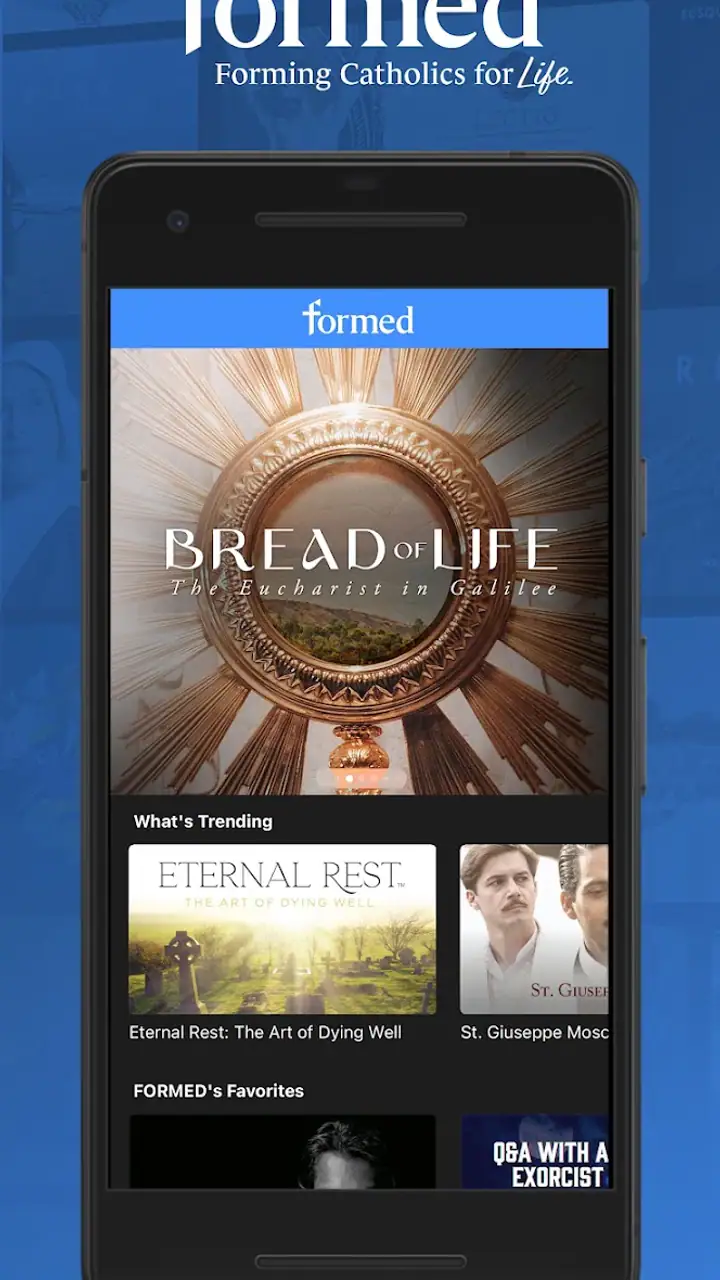
Because Formed is associated with Catholic formation, a new user may wonder whether it is intended only for advanced learners, parish leaders, or families. I found it more useful to think of it as a broad learning space. You do not need to approach the app as if you are preparing for an examination. Start with a subject you genuinely want to understand, and let the difficulty increase naturally as your confidence grows.
The app is available for Android devices running at least version 8.0, and the current version is 10.303.1. That makes compatibility worth checking before installation, especially if you are using an older phone or tablet. On a supported device, I would allow a few minutes for the app to settle, explore the main navigation, and identify where educational material is organized. Doing this once prevents the common mistake of judging the app after only seeing its opening screen.
Formed is free to download, but it includes optional in-app purchases ranging from $0.99 to $99.99 per item. For a first-time user, that means I would avoid assuming that every part of the experience has the same access conditions. Begin with the material available to you, understand how the app presents its options, and decide later whether anything paid is genuinely useful for your needs. The presence of purchases does not make the app unsuitable, but it does make it sensible to read each prompt carefully before confirming anything.
One practical setup tip is to choose a regular place and time for using it. A phone is full of distractions, so I get better results when I open Formed at a predictable moment rather than waiting for an undefined block of free time. A quiet morning, a short evening period, or a weekly family session can work. The exact schedule matters less than making the app part of an existing habit.
How to reach a first meaningful result
The first successful action should not be “I looked through every category.” It should be completing one focused learning session and being able to explain what you took from it. I suggest choosing one topic that connects with a real question in your life. For example, if you want to understand a part of Catholic practice that has always felt unclear, use that question to guide your selection instead of opening items at random.
Once you have chosen something, remove as many interruptions as possible. Put the phone on silent, keep a note nearby, and write down one phrase or idea that you want to remember. This small step changes the app from passive viewing into active formation. It also gives you a simple test: after the session, can you describe the main point in your own words? If you can, the first use has already produced something valuable.
Families can adapt the same approach. Rather than asking children to browse independently, an adult can select one suitable subject beforehand and use it as the starting point for a conversation. The goal does not have to be a formal lesson. A parent might ask what stood out, what seemed difficult, or how the idea connects with daily life. This makes the app a prompt for discussion instead of another screen competing for attention.
For individual users, a useful workflow is to keep a short “return list.” When something raises a question, note it rather than abandoning the current session to search for an answer immediately. This prevents a common problem with educational apps: following one interesting thought after another until the original lesson is forgotten. Formed is more effective when I finish one subject before opening a new trail.
Another non-obvious strength is that it can serve different levels of commitment without requiring the same routine from everyone. A person with only a few minutes can use it as a starting point for reflection, while someone studying more seriously can build a longer sequence around a theme. The trade-off is that the app does not automatically create discipline for you. If you need a teacher, deadlines, and regular assignments, a parish course or formal program may be the better choice.
Confusion new users may run into
The biggest source of confusion is likely to be the difference between downloading the app and understanding how access works. Since Formed is free to install and also offers in-app purchases, I would pay attention to the wording around any locked or premium-looking material. Do not assume that seeing a title means every part of it is immediately available, and do not purchase anything simply because you feel you must unlock the app to begin learning.
A second point is the difference between content discovery and spiritual direction. Formed can help me learn about Catholic subjects, but it cannot know my personal circumstances in the way a priest, catechist, or trusted parish mentor can. If I am dealing with a serious moral, pastoral, or sacramental question, I would use the app for background and preparation, then speak with an appropriate person. Treating an educational resource as a replacement for personal guidance would be an unfair expectation.
Some users may also be unsure whether a short session “counts” if they do not finish a large topic. I think this is the wrong standard. The app is easier to sustain when I measure progress by understanding rather than by quantity. One idea remembered and applied is more useful than several items opened and quickly forgotten.
There is also a practical attention problem. Because the app lives on a phone, notifications and unrelated habits can weaken the experience. I recommend opening it with a clear intention and leaving once the planned session is complete. This sounds simple, but it preserves the difference between using Formed as a learning tool and merely consuming another stream of digital content.
Users who are not Catholic, or who want a broad comparison of many religions, should probably choose a different education app. Formed has a specific Catholic purpose, and that focus is precisely what makes it useful for its intended audience. Someone looking for neutral religious studies, academic history, or a general philosophy course may find a university resource or a wider reference library more appropriate.
Turning one session into a lasting routine
After the first successful session, I would resist the temptation to jump through unrelated material. Choose a theme and stay with it for a while. A sequence built around one question gives the app more educational value than collecting a long list of titles that you never revisit. This is especially helpful for beginners, because related lessons reinforce vocabulary and make later ideas easier to understand.
A good next step is to share what you learned with one other person. That could be a family member, a friend from church, or someone who is also exploring Catholicism. Explaining a subject exposes the parts you understand and the parts you only recognize vaguely. If a conversation reveals a difficult question, record it and use it to guide your next session rather than seeing the uncertainty as failure.
For parents, the most effective routine may be short and predictable rather than ambitious. Pick material in advance, decide how long the conversation will last, and finish with one question children can answer in their own words. The app should support family life, not turn every evening into a classroom. If a child is tired or distracted, a shorter discussion may be more productive than forcing the full lesson.
For adults returning to Catholic practice, Formed can be a gentle way to rebuild familiarity without feeling exposed in a group setting. I appreciate that private learning can lower the barrier to asking basic questions. At the same time, private study should not become a permanent substitute for community. Once the app helps you identify what you want to explore, a parish conversation or local group can add the human context that a phone cannot provide.
The developer, The Augustine Institute, gives the app a clear identity rather than trying to make it a generic religious content platform. That focus is valuable when I want Catholic material gathered in one place. It also means I would not recommend it to someone who wants an entirely open-ended collection of viewpoints. The narrower scope is a feature for the right reader and a limitation for the wrong one.
My recommendation after using it
I see Formed as a strong choice for Catholics who want accessible education that can fit around ordinary life. Its free entry point makes it easy to test, its Everyone age rating keeps it approachable, and its high user rating reflects the fact that it has found an audience. I especially like it for people who are curious but hesitant, parents looking for a starting point for family conversations, and practicing Catholics who want a more intentional learning habit.
I would be more cautious about recommending it to someone who needs live instruction, formal assessment, or direct personal counseling. I would also steer a non-Catholic religious-studies student toward a broader and more academically neutral resource. The app’s value comes from its Catholic focus, so that focus should match what you are looking for.
My practical advice is to install it, choose one question, and complete one undistracted session before making any decision about optional purchases. If that first experience leaves you with a clearer understanding or a better question to ask, continue with a small weekly routine. If you only find yourself browsing without learning, a book, parish class, or conversation with a mentor may serve you better.
Overall, Formed succeeds when I use it deliberately. It is not a magic shortcut to spiritual growth, and it does not remove the need for community or personal guidance. What it does offer is a convenient, focused place to begin or continue Catholic education. For a first-time user, that is enough: start with one subject, finish one meaningful session, and let the next step grow from what you genuinely want to understand.
FAQs for Formed
What is Formed and what can I use it for?
Formed is an app designed to help users organize, create, or manage their personal information and activities through a streamlined mobile interface. Depending on the features available in your region and version, it may be useful for completing forms, storing details, tracking progress, or handling structured tasks. Before downloading, review the official description carefully to confirm that its tools match your specific needs.
Is Formed free to download and use?
Formed may be available as a free download, but some functions could require in-app purchases, a subscription, or payment for premium services. The free version may include limitations such as restricted features, advertisements, storage caps, or fewer customization options. I recommend checking the app store listing and subscription terms before creating an account, especially if a free trial automatically changes into a paid plan.
Does Formed protect my personal information?
Because an app like Formed may handle names, contact details, documents, forms, or other sensitive information, privacy should be considered before use. Check the developer’s privacy policy to understand what data is collected, where it is stored, and whether it is shared with third parties. Avoid uploading confidential information until you are comfortable with the app’s security practices and permissions.
Can I use Formed without an internet connection?
Offline availability depends on the specific tools you plan to use. Some parts of Formed may work without an active connection, such as viewing previously saved content or editing locally stored information, while account synchronization, cloud backups, sharing, and certain online services may require internet access. If reliable offline use is important, test the app after installation and confirm which features remain available.
Which devices and operating systems support Formed?
Formed’s compatibility can vary between Android and iOS, as well as between older and newer operating-system versions. Before downloading, check the official store page for supported devices, required system versions, available storage, and any regional restrictions. Keeping your phone updated generally improves stability, but older devices may experience slower performance or may not support every feature included in the latest release.
Pros
- Simple interface makes form creation quick for beginners.
- Supports digital signatures for more complete submissions.
- Templates help reduce repetitive data entry.
- Works well for organizing forms in one place.
- Useful for collecting structured information remotely.
Cons
- Some advanced features may require a paid plan.
- Customization options can feel limited for complex forms.
- Large forms may take longer to load on older devices.
- Users may need an account to access certain tools.
- Offline functionality may be limited or unavailable.


